
Sewer Pipe Cleaning Machine Factory in China Builds Equipment for Global Municipal Projects
2026-11-20
Behind every major municipal sewer project, there is equipment that rarely gets attention until something goes wrong. In China, one factory is quietly changing that. AMJET builds sewer pipe cleaning machines engineered for the demands of city-scale maintenance, from routine flushing to emergency blockage removal. As municipal crews across different continents face aging infrastructure and tighter budgets, the machines they choose are becoming a strategic decision rather than a simple purchase. This blog looks at how AMJET designs equipment that travels from a production line in China to underground pipes around the world, and why more project managers are paying attention before the next clog becomes a crisis.
Where Municipal Crews Get Heavy-Duty Sewer Cleaners That Survive the Job
Most municipal crews don't shop around the way a homeowner might. They work through cooperative purchasing agreements and pre-negotiated contracts that give public works departments access to industrial-grade jetting and vacuum units without running a lengthy bid process each time a truck wears out.
A lot of the heavy-duty equipment comes straight from regional dealers who stock replacement parts and keep factory-trained mechanics on call, because a sewer cleaner parked in the yard waiting on a backordered pump isn't doing anyone any good. Fleet managers tend to favor vendors who can deliver a demo unit to the shop and let the crew run it through actual clogged lines before the city signs anything.
Some of the harder-wearing machines also come out of state surplus programs or are rebuilt by specialty shops that strip units down to the frame and replace the high-wear components—hoses, nozzles, vacuum blowers, and hydraulic controls—so a smaller town can get a machine that will last another decade without the brand-new price tag.
Inside a Chinese Workshop Turning Steel into Reliable Drainage Equipment
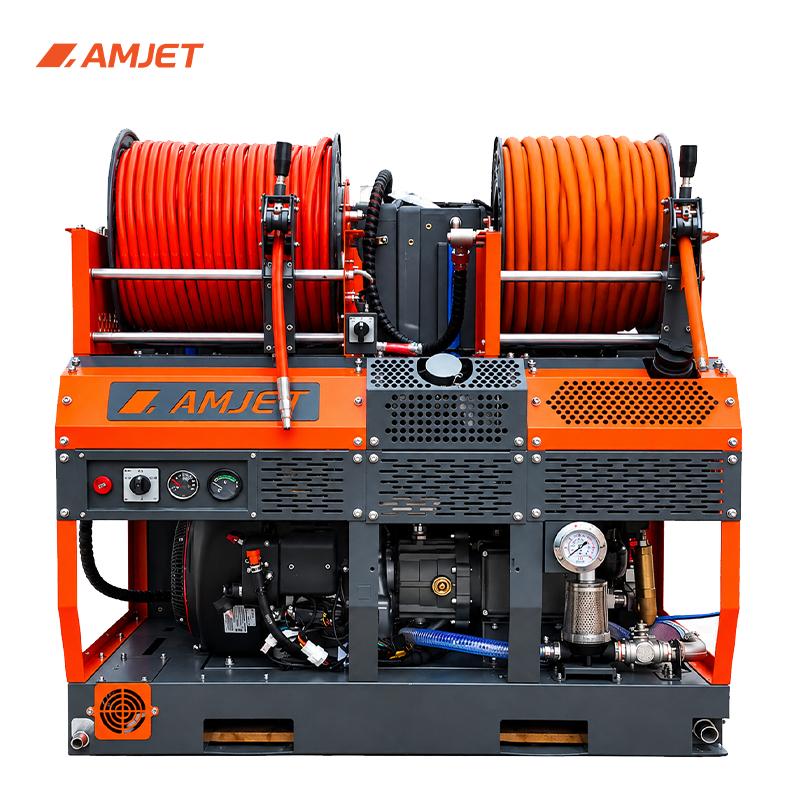
Steel coils arrive still smelling of mill oil, and the first stop is a shear that cuts them into blanks with a dull thud. The operators work from chalk marks and paper drawings taped near the controls, checking each batch against a worn steel ruler before it moves on. From there, press brakes fold the flat stock into channel sections, and the seams are welded in short, controlled passes to limit warping.
After welding, the pieces take a dip in a zinc-rich coating bath, then hang from overhead rails to drip dry above a grated floor. The coating crew works by feel as much as by specification, brushing extra compound into bolt holes and rough edges where rust tends to start. A quick visual check sends anything with thin coverage back for another pass.
Before anything leaves the workshop, it is filled with water and left under pressure for hours. Pipes are capped, joints inspected with a flashlight, and any damp spot on the concrete means the unit is pulled aside. The ones that stay dry get a stenciled batch code and are stacked near the loading door, ready for truck beds already caked with mud from previous runs.
Why Project Managers Look Beyond Local Suppliers for Pipeline Maintenance Gear
Pipeline maintenance rarely allows room for equipment that is close enough. Project managers often begin with nearby vendors, but the search widens once specifications include uncommon diameters, higher pressure classes, or coating requirements tied to aggressive soil conditions. Local stock tends to cover routine plumbing and light industrial use, which means ordering specialized repair sleeves, isolation plugs, or high-yield fittings through a regional supplier frequently leads to long backorder notices rather than shorter lead times.
There is also a documentation and traceability factor. Maintenance crews need material certificates, weld procedures, and pressure-test records that hold up during audits or incident reviews. A supplier three states away may be less convenient on paper, but if they can provide full batch traceability and consistent inspection paperwork, that reduces the project manager's administrative risk more than a same-day pickup from a local counter ever would.
Finally, experienced managers treat procurement as part of the schedule rather than a one-time purchase. They compare not just unit price, but the cost of a crew standing idle while a fitting is shipped twice because the first part did not match the original spec. Broader sourcing often wins because it stabilizes delivery dates, simplifies warranty claims, and gives maintenance teams access to manufacturers who actually understand the operating conditions of midstream assets.
How Custom Builds Help Cities Handle Fatbergs, Roots and Storm Debris
Municipal sewer crews often deal with blockages that standard equipment was never designed to handle. Fatbergs grip pipe walls like hardened wax, tree roots squeeze through joints and spread into dense mats, and storm debris arrives in unpredictable mixes of branches, silt, and trash. Off-the-shelf cleaning rigs can struggle with these jobs because they are built around generic pipe sizes and average viscosity. Custom builds change that by letting a city adapt the machine to the actual conditions underground, from narrower cutter heads for old brick sewers to higher-torque augers that chew through compacted grease without simply pushing it further downstream.
A custom approach also helps with the mixed nature of post-storm blockages. Instead of sending a standard vacuum truck into a flooded culvert, crews can specify debris baskets with wider intake throats, heavier impellers for muddy water, and boom-mounted cameras that pivot beneath low overpasses. For root intrusion, cutter assemblies can be built with interchangeable blade profiles and adjustable depth stops, allowing operators to shave roots back without scoring the pipe lining. Fatberg removal benefits from heated spray bars and precisely angled nozzles that soften the mass in layers rather than blasting it into chunks that would only re-form farther along the line.
The real advantage is repetition without rigidity. Once a city understands the failure patterns in a particular district, it can refine a standard platform into several targeted variants, each one set up for the blockages that keep returning. Maintenance yards stock fewer one-size-fits-all attachments and more purpose-built components matched to local manhole sizes, pipe materials, and seasonal debris loads. Crews spend less time improvising in the field, and the city avoids the cost cycle of repeatedly renting specialty equipment. Over time these custom machines become part of the routine, making severe blockages feel less like emergencies and more like manageable maintenance.
The Journey of a Municipal Machine from Factory Floor to Five Continents
It starts with a torque wrench and a checklist. On the factory floor, the machine is not yet a municipal workhorse—just a chassis, a hydraulic tank, a cab shell, and a tangle of wiring that will soon become a street sweeper or a compact refuse collector. Each bolt is logged, each pump tested against a pressure curve, and the people on the line speak about it the way stable hands speak about a horse: it has a temperament, a weak side, an idle rhythm that tells you whether it will hold up. By the time the paint cures and the first engine start clears the exhaust bay, the machine already has a file thicker than a phone book. That file travels with it.
From there, the machine is partially stripped for shipping—mirrors folded, antennas removed, fluids drained to satisfy maritime rules. It rolls into a container in a port city, gets lashed down with chains, and spends weeks at sea. Salt air finds its way into places the factory never imagined. On arrival, local crews reinstall the parts, reprogram the control unit for a different voltage, different signage, sometimes a different side of the cab. A machine built for narrow European streets may need its turning radius recalibrated for a sprawling Latin American grid. It is less a simple export than a translation.
Months later, it may be sweeping dust in Accra, clearing snow in Oslo, hauling market waste in Manila, or washing sidewalks in Melbourne. The same hydraulic whine, the same warning beep when it reverses, but the sounds now belong to different mornings. The factory floor is far away, yet its fingerprints remain in every relay and weld. Five continents, dozens of municipalities, one machine that keeps adapting without quite losing where it came from.
What Actually Matters When Specifying a Sewer Pipe Cleaner for Public Works
A spec sheet full of impressive horsepower numbers doesn't mean much if the unit can't handle the daily grind of municipal work. The real questions start with the pipe conditions crews actually face: are they dealing with decades-old clay lines, heavy grease buildup, or root intrusion in lines that shift with freeze-thaw cycles? A machine that looks great on paper but stalls out on a packed debris plug at 200 feet won't make it past the first week on the job. Look for a cleaner that balances water pressure and flow rate against the nozzle choices available, because that combination determines whether you're actually clearing the line or just giving it a rinse.
Beyond the initial punch, pay attention to how the unit behaves when things go wrong. Public works crews rarely get to work a clean, empty pipe under ideal conditions. They need a reel that doesn't tangle when someone yanks the hose back from a stubborn blockage, controls that can be operated with gloved hands in the rain, and an engine layout that doesn't require a contortionist to reach the filter or check the oil. Vibration isolation, hose guides, and a frame that survives being bounced down a gravel access road matter more than a polished paint job.
Finally, think about the support behind the machine. The best sewer cleaner in the world is a paperweight if you can't get a replacement pump part during a storm event. Ask the manufacturer where their service centers are, how long parts actually take to arrive, and whether their training covers the kind of varied pipe systems your crews encounter every day. A lower bid that comes with a two-week wait for a solenoid or a confusing manual will cost far more in overtime and frustrated operators than the premium machine from a vendor who picks up the phone.
FAQ
The lineup covers truck-mounted jetting units, trailer-mounted jetters, vacuum combination machines, and smaller skid-mounted systems for narrow urban access. Each model is built around the same core pump and filtration components but can be configured with different tank sizes, hose reels, and nozzle kits.
The engineering team usually starts with local road regulations, emission standards, and common pipe diameters. From there they adjust axle loads, engine options, pump ratings, and even control labels. Some regions want hot-dip galvanized frames for coastal corrosion, while others prioritize cold-weather start performance.
Yes. A municipality can send drawings of its existing fleet, typical manhole depths, and debris samples. The factory then proposes a tank volume, pump flow, hose length, and reel placement that fit those working conditions. Custom builds go through a prototype review before mass production.
Each unit goes through a pressure test on the pump and hose circuit, a full-function test on the boom and reel, and a road test when the chassis allows it. Weld seams on tanks are inspected with dye penetrant, and electrical harnesses are checked against a wiring diagram before final sign-off.
The China plant keeps a bonded inventory of common wear items like nozzles, seals, and filters, and ships them with the machine or separately by air freight. For larger municipal fleets, the factory can set up a local consignment stock and train the city's maintenance crew on routine service tasks.
Training usually combines on-site sessions with video calls and printed manuals. Operators learn safe hose handling, nozzle selection, daily pump maintenance, and troubleshooting for high-pressure water loss. For projects with many machines, the factory can send a commissioning engineer for the first two weeks.
The equipment ranges from compact units for 100 to 300 millimeter laterals to high-flow combination machines that clear 800 millimeter trunk sewers with heavy silt, grease, and roots. The pump and vacuum systems can be tuned for long hose runs, steep gradients, or abrasive sand and gravel.
Yes, the factory has delivered units to city contractors in Southeast Asia, the Middle East, East Africa, and Latin America. One recent batch was configured for narrow streets with a short wheelbase and an extra water tank because hydrant access was limited in the client's service area.
Conclusion
Municipal sewer work eats equipment. Crews in Toronto, Brisbane and Hamburg don’t need a glossy catalogue; they need a machine that clears packed grease, root masses and storm debris without folding by the second shift. A number of Chinese factories making sewer pipe cleaners have learned this through years of export orders and field returns. The better ones build around thicker drum walls, guarded drive chains and pump seals rated for grit, not just clean water. Buyers who once sourced locally now place repeat orders after comparing frame steel, nozzle kits and bearing access side by side with machines from Germany or the United States.
Custom requests drive much of the work. A city dealing with fatbergs may want a different hose reel and higher flow than a coastal town clearing sand and leaves after storms. Engineers on the factory floor adjust the reel capacity, motor output and trailer layout before the unit is crated. Then it gets bolted into a container, shipped to port, and usually assembled or inspected by a local dealer. What separates a useful purchase from an expensive mistake is rarely a spec sheet headline. It is the availability of spare nozzles, the clarity of wiring diagrams, and whether the manufacturer answers calls when a pump acts up six months later. That practical record is why these machines now run in depots across five continents.
Contact Us
Contact Person: Mike
Email: [email protected]
Tel/WhatsApp: +86 19545555505
Website: https://www.amjeting.com/