

Professional Travertine Flexible Stone Elevates Interior Wall Design with Natural Texture
2026-08-18
Imagine the warmth of natural travertine wrapping your interior walls—yet so light and flexible it bends around curves and corners without a single crack. That’s exactly what Magic Stone delivers with its professional travertine flexible stone. Gone are the days of heavy slabs and tedious installation. Here’s how this innovative material is rewriting the rules of wall design with authentic texture and effortless elegance.
The Flexible Stone That Removes the Trade-Off Between Texture and Weight
Traditional stone cladding forces a choice—either accept the visual depth and tactile richness of real rock, or compromise with lightweight imitations that look flat and artificial. Flexible stone changes that equation. It is engineered from thin layers of natural minerals bonded to a pliable backing, preserving the grain, pores, and subtle color shifts of quarried stone while weighing a fraction of the original.
The weight reduction does more than ease handling. It opens up surfaces that were never practical for heavy slabs: curved walls, ceiling soffits, cabinetry, and even furniture. Installers can cut it with standard tools, wrap it around tight radii, and apply it with simple adhesives, eliminating the need for steel supports or specialized masonry crews.
Because the product is so light, freight costs drop and structural loads stay within standard residential limits. Yet the finished surface carries the same shadow play and mineral variation that make natural stone desirable. For architects and designers, that means texture no longer has to be traded away for weight—or the other way around.
Travertine Character Without the Masonry Timeline
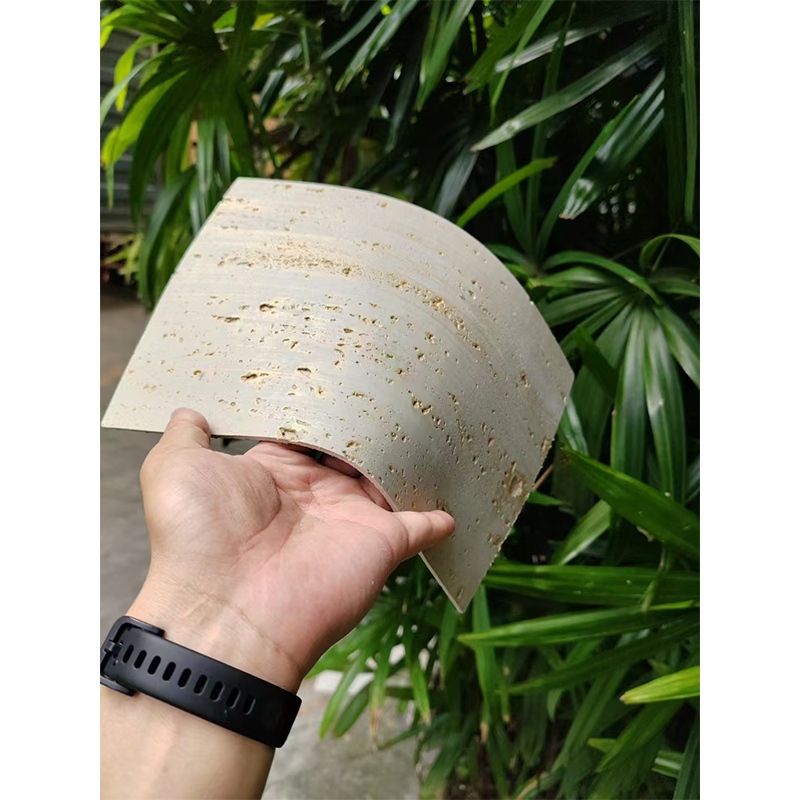
Strip away the dates, the quarries of ancient Rome, the layered stories of empire and ruin. What remains is the stone itself: a surface full of open pores and soft, irregular hollows that catch shadow in ways no polished slab can imitate. Travertine’s real character doesn’t come from its place on a timeline—it comes from the way light moves across its uneven face and the quiet warmth of its cream, walnut, and ash-grey bands.
Used in a contemporary room, the material refuses to behave like a background surface. It holds marks of its own formation, tiny cavities and faint mineral streaks that read as texture rather than flaw. That visual depth gives interiors a grounded, unhurried feel. You don’t need to know when it was first carved to sense that it belongs exactly where it sits.
Wall Surfaces That Borrow From Ancient Roman Warmth
There is a particular kind of wall that seems to hold the day’s last sunlight long after the room has dimmed. It is not merely painted or papered, but finished with lime plaster mixed with crushed terracotta, a recipe that would have been familiar to a Roman builder. The surface has a soft, almost breathable texture, and its color shifts from dusty rose to ochre depending on the hour. Run a hand across it and you feel tiny irregularities, like the memory of a trowel’s edge. This is not a reproduction of antiquity but a conversation with it—walls that absorb and release light, making interiors feel inhabited rather than decorated.
What makes these surfaces so welcoming is their refusal to be uniform. Modern drywall is flat and silent, but a Roman-inspired plaster carries visible traces of handwork: subtle undulations, faint sand grains, a gentle bloom of salt in a corner. These imperfections draw the eye slowly, the way one might study an old fresco. The warmth is not only visual. Terracotta, once fired and ground, holds thermal mass, so the wall stays cool in summer and slowly gives back warmth in winter. It is a quiet efficiency, earned through material rather than machinery.
In contemporary rooms, such a wall acts as an anchor. Against sleek furniture or raw linen, it introduces a note of age that makes everything else feel more alive. A single accent wall can change the acoustics of a space, softening echoes with its slightly porous skin. You might choose a warm biscuit tone for a dining room, where candlelight will deepen its hue, or a pale earthen shade for a bedroom, where it will read as calm rather than heavy. In every case, the surface borrows not just the Romans’ technique but their understanding that a wall should be touched by time, not immune to it.
How Curved and Unusual Walls Finally Get Their Stone Finish
Flat walls make stone installation look easy. A curved wall, on the other hand, used to send even seasoned tilers looking for alternative materials. The problem is basic: stone doesn't bend, and any attempt to force a rigid slab around a radius ends with hairline fractures or ugly lippage. That's why so many curved fireplace surrounds or rounded entryways from past decades ended up wearing faux-stone veneer or just painted drywall—it was the only way to avoid a costly mess.
The breakthrough came from rethinking how stone gets applied, not from making stone softer. Thin stone veneers, some just 3–5 mm thick, now flex enough to hug a gentle arc without cracking. For tighter curves, installers abandon large panels altogether and work with small-format pieces—narrow strips, tumbled cobbles, or mosaic sheets with mesh backing. Each piece gets set individually, and the grout joints expand or contract slightly to absorb the geometry. For truly bespoke curves, fabricators use CNC water jets to slice a single stone slab into interlocking curved segments, then reassemble them on the wall like a three-dimensional jigsaw.
The result is a finish that looks as if the stone grew there. No more painted-on texture or plastic-looking panels. A curved stone wall can now be the focal point it was meant to be, whether it's a barrel-vaulted shower, a rounded kitchen island base, or a wave-shaped feature wall in a lobby. It's slower work and costs more than flat installation, but the payoff is genuine stone following a line that used to be off-limits.
Natural Veining That Changes With the Light
Hold a slab of this stone near a window and the veins take on a life of their own. In low, raking light the thinner lines gleam like threads of mica, while the broader bands drop into shadow. Tilt the surface just a few degrees and a completely different pattern emerges—veins that seemed faint now look as if they've been drawn in graphite.
This isn't a static finish. The way the veins respond to light means the piece reads differently from morning to evening. Pale gold veins may warm under incandescent bulbs, then turn cool and almost blue when daylight hits from the north. It's a subtle shift, but once you notice it, the material feels less like a flat surface and more like a mineral landscape caught in motion.
For anyone choosing this stone, that changing quality is part of the appeal. You don't just pick a color; you pick a particular day of light. The veining reveals one story under a single bulb and another under an overcast sky, so the same countertop or table never feels quite the same twice.
What Installers Wish More Designers Knew About Flexible Travertine
Substrate prep is make-or-break. Flexible travertine doesn't hide waviness. If drywall seams or patches aren't flat, the stone will telegraph every bump once light hits it. Use a primer appropriate for the adhesive, and don't assume standard thin-set works like it does for tile. Because the panels are thin and somewhat porous, a high-quality polymer-modified adhesive with a notched trowel suited to the panel thickness prevents sag and hollow spots. Let panels acclimate to the room for 24-48 hours before installation.
Designers sometimes treat flexible travertine as a veneer that can wrap any radius, but there are real limits. Tight corners, sharp returns, or narrow bullnose profiles often crack the stone chips or pop them from the backing. Keep inside and outside corners to a minimum radius the manufacturer actually publishes, and plan for a clean seam or a trim piece at transitions. Also expect visible joins between sheets; feathering the edges and using matching grout helps, but the seam won't disappear completely.
Finishing steps are not optional. Seal the travertine before grouting to keep pigment from staining the porous surface, then seal again after grout cures. Installers also need proper working time—once adhesive skins over, repositioning a panel becomes messy. And don't spec dark grout on a light honed sheet unless you've tested it; the contrast can look speckled and less like natural stone. Knowing these details ahead of time saves callbacks.
FAQ
It delivers the layered, porous look of quarried travertine without the weight or installation hassle, so a single accent wall can feel like carved stone while remaining easy to cut and shape.
The natural tonal shifts and subtle pits catch light unevenly, giving the wall a soft, aged presence that makes the space feel more grounded and less flat than painted drywall.
Yes, because it is thin and pliable, it often bonds directly to smooth plaster, drywall, or tile, which means you can refresh a room's look without tearing out the old wall first.
They work across a fairly wide range, from warm minimalism and Mediterranean-inspired interiors to contemporary spaces that need a raw, organic counterpoint to glass or metal.
Not particularly. Occasional dusting and wiping with a damp, soft cloth are usually enough, though sealing can help protect the porous surface in high-traffic or splash-prone areas.
There is intentional variation, which is part of the appeal. Each panel carries its own veining and pit marks, so the finished wall reads as a genuine stone surface rather than a repeated pattern.
They should use a suitable adhesive, avoid stretching the material too aggressively around corners, and plan seam placement so the texture flows naturally across the wall.
It tends to cost less and is easier to handle, yet from a normal viewing distance it still offers the convincing organic relief and warm beige tones that people expect from real travertine.
Conclusion
Interior walls no longer have to choose between the weight of quarried travertine and the hollow look of printed panels. Professional Travertine Flexible Stone brings actual stone texture to a lightweight, bendable surface, so designers can wrap columns, arches, and curved partitions without reinforcing framing or scheduling a masonry crew. The material keeps the soft beige strata and irregular pores that have made travertine feel warm since ancient Roman baths, but it arrives in rolls, cuts with a utility blade, and installs in a fraction of the time. Because the veining sits in a real mineral layer rather than a flat film, it shifts subtly as light crosses the wall—morning glare picks out one band of fossils, evening lamps catch another.
Installers often point out that the product's forgiving nature is its biggest advantage: seams disappear more easily than rigid stone, and off-angle corners become simple overlaps instead of failed miters. Yet many designers still specify heavier tile out of habit. Once they see how the flexible sheet follows a curved niche or a vaulted ceiling without buckling, the trade-off disappears. The result is a room that feels carved from a single block of Roman travertine, but without the dust, delay, or structural weight. That combination of speed, texture, and warmth is what lets flexible stone quietly outperform both faux finishes and traditional slab work.
Contact Us
Contact Person: Vito
Email: [email protected]
Tel/WhatsApp: 86 13088879266
Website: https://www.magicstonemcm.com