

Gel Seat Cushion Supplier: Your Guide to Comfort That Lasts All Day
2026-11-16
Most people don’t realize their chair is the problem until their lower back starts a full-scale protest. A genuine gel seat cushion—one that actually keeps you cool and supported through hour eight—depends entirely on the supplier behind it. That’s where Kunbao separates itself. In this guide, we skip the gimmicks and look at what makes a cushion last all day: pressure relief, breathability, and a manufacturing partner who treats comfort as an engineering goal, not a marketing line. Whether you’re outfitting an office, a fleet of drivers, or just your own home desk, understanding the difference a trusted gel seat cushion supplier brings is the first step to sitting without the squirm.
The Real Difference Between a Good Gel Cushion and a Great One
Most people assume the gap between a good gel cushion and a great one comes down to thickness or brand name. But after sitting on dozens of them, the real difference is how the gel layer behaves under sustained pressure. A good cushion softens the first ten minutes; a great one keeps redistributing weight two hours in, without letting your sit bones bottom out against the chair.
The material quality is another quiet separator. Many budget options use gels blended with plasticizers that slowly harden or even seep in warm weather. A great cushion uses a medical-grade or high-resilience polymer that holds its structure across temperature shifts and repeated use. You can feel it in the way the surface stays cool and consistent rather than turning sticky or lumpy by mid-afternoon.
Then there's the failure test. With a good cushion, the first sign of trouble is usually edge collapse—the perimeter starts folding inward, and the seat becomes a shallow bowl. A great one maintains its profile because the gel is poured or molded with density variations that support the thighs and tailbone differently. That's the kind of detail you won't notice on day one, but your back will thank you for by the end of the month.
What Your Current Supplier Probably Isn't Telling You About Gel Density
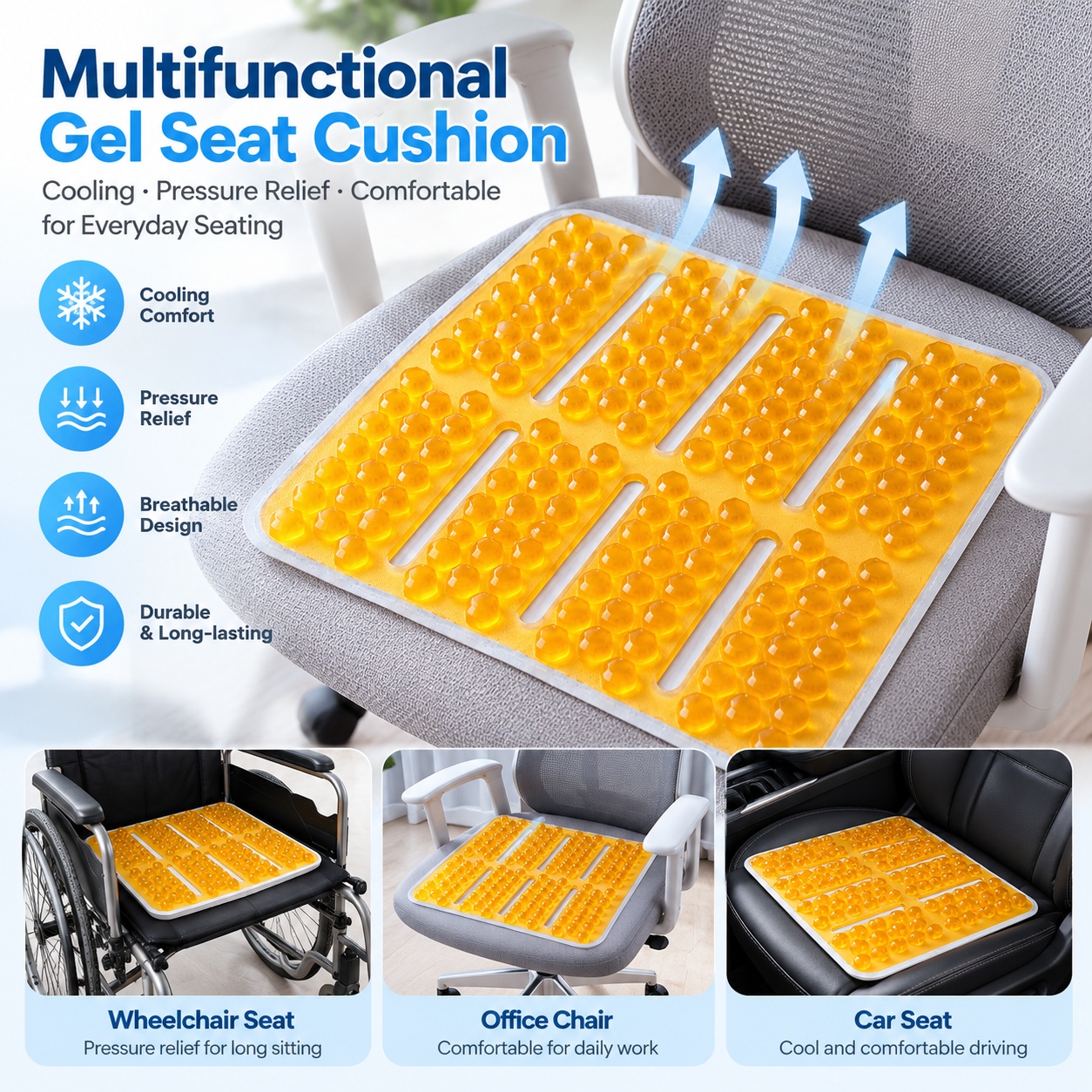
Most suppliers quote a gel density number and leave it at that, but the real story lives in how that number shifts under load and temperature. A gel rated at 75 kg/m³ can feel completely different from another with the same spec if the polymer network wasn't cured evenly. Ask for the density tolerance, not just the target. If they hesitate, that's a clue the batches vary more than the datasheet suggests.
You'll also find that density alone says little about cushioning recovery or long-term compression set. Two gels can share an identical density yet one bottoms out after six months while the other holds its shape for years. The missing detail is usually the crosslink density — something suppliers rarely volunteer because it dictates both cost and performance. Push for a stress-strain curve or a compression set percentage at your operating temperature, and you'll quickly separate what's engineered from what's merely weighed.
Turning All-Day Sitting Into a Non-Issue: A Practical Approach
The real problem isn't sitting itself—it's sitting the same way for hours without a break. You don't need a standing desk or a gym membership to fix this. Start by noticing the moments when your body starts to hold tension: maybe your shoulders creep up during emails, or your lower back stiffens after a long call. Use those as cues to change something small: roll your chair back, sit cross-legged for a minute, or shift your weight to one hip. None of these take more than a breath, but they interrupt the static pattern that makes all-day sitting feel miserable.
Another approach is to stop thinking of movement as a separate block of time. If you're on a video call that doesn't require your camera, stand up and pace for the first few minutes. Read a document while leaning against a counter. Take your next cup of tea standing by the window instead of at your desk. These aren't workouts—they're just ways to make your default position less rigid. The goal is to build in enough variety that your body doesn't get stuck in one posture long enough to complain.
Finally, adjust your environment so that the easiest choice is also the more active one. Place your printer across the room, keep your water bottle small so refills are frequent, or set a timer that reminds you to switch from sitting to perching on a stool. None of this requires willpower if the setup does the work for you. Over time, these tiny shifts add up to a day where sitting no longer feels like a threat you're trying to survive.
How to Ask the Right Questions Before Placing a Bulk Order
Before you commit to a large purchase, nail down the exact product specifications. Ask the supplier to confirm dimensions, materials, tolerances, and any custom features in writing. If you're ordering samples first, compare them against your approved prototype and flag even minor deviations. This prevents costly surprises when the full shipment arrives.
Next, dig into production timelines and logistics. Find out how long the factory needs to complete the order, whether they can handle your requested volume within that window, and what happens if they fall behind. Clarify packaging requirements, shipping terms, and who bears responsibility for damage in transit. These details affect your total landed cost and your ability to restock on schedule.
Finally, understand the supplier's quality control and after-sales policies. Ask how they inspect products before shipping, what defect rate they consider acceptable, and what remedy you have if items arrive damaged or out of spec. A clear agreement on returns, refunds, or replacements protects your cash flow and keeps your relationship with the supplier on solid ground.
Materials That Keep Their Shape When Everything Else Gives Up
Most materials eventually wave the white flag under enough stress—bend them, heat them, or just let time do its work, and they'll sag, crack, or flow into something unrecognizable. But a peculiar class of substances refuses to play along. Shape-memory alloys, for instance, can be crumpled like a soda can and then, with a splash of hot water, spring back to their original form as if nothing happened. It's not magic; it's a reversible phase change at the atomic level, where the metal shifts between two crystal structures without losing its memory of the starting shape.
Scientists have long been obsessed with this stubbornness—not just for the novelty, but because it solves real problems where failure isn't an option. Think of a stent squeezed through a narrow artery, then expanding to hold the vessel open once it reaches body temperature. Or a satellite antenna that unfolds in orbit after being packed tight for launch. The material doesn't resist deformation forever; it simply waits for the right trigger to undo it. That delayed resilience is what makes these alloys feel almost alive.
Of course, the concept stretches beyond metals. Researchers are now tinkering with polymers and ceramics that mimic the same trick: deform them past their usual breaking point, and they recover when you dial in light, moisture, or an electric field. The real hurdle isn't finding materials that can take a beating—it's finding ones that know exactly when to bounce back. In an era of disposable everything, there's something quietly radical about stuff that refuses to stay broken.
From First Sample to Final Delivery: Avoiding Costly Surprises
The gap between an approved sample and the shipped product is where margins quietly disappear. A factory may sign off on a first article that meets every tolerance, then gradually change thread suppliers, reduce stitching density, or alter fabric weight once full production gets underway. Without a locked baseline—a sealed reference sample, a measured spec sheet, and clear photos from multiple angles—those small deviations go unnoticed until a container arrives with noticeably thinner material or off-register printing. By then, the options are grim: discount the goods, pay for rework, or fight a dispute with limited evidence.
Treating the original sample as the contract changes the dynamic. Keep the approved reference dated and sealed, and require batch samples to be pulled and checked against it at set production milestones, not just at the end. Ask the factory to send a brief video of the actual line running your item, which tends to reveal more than staged photographs. For details that often drift—dye lots, hardware finish, fill weight, seam alignment—agree on an acceptable variance in writing before the first sample is approved. When an issue does surface, a documented chain from sample to shipment keeps the conversation focused on solving the problem, not on arguing over who changed what.
FAQ
Look for a supplier that offers material transparency, such as the type of gel used and its density. Ask about production consistency and whether they provide samples before you commit. A dependable supplier should also be willing to discuss weight limits, thickness options, and how their cushions perform in different temperatures.
A well-made gel cushion distributes weight evenly, which helps prevent pressure points from forming during extended sitting. The gel doesn't break down as quickly as standard foam, so you can expect consistent support for several years if the cover and inner layers are built properly. Keep in mind that direct sunlight and rough use will wear it out faster.
Most established suppliers accept custom orders, but the minimum quantity often rises compared to stock options. You'll usually need to provide exact dimensions and desired thickness. Be prepared for a longer lead time, as molds and tooling may need to be created or adjusted.
The main differences come down to gel density, cover material, and overall construction. Quality cushions use a gel layer thick enough to prevent bottoming-out, paired with a breathable cover that resists slipping. Cheaper versions may use lower-grade gel that flattens quickly or covers that trap heat and make sitting uncomfortable.
Most cushions can be wiped down with a damp cloth and mild soap. If the cover is removable, wash it according to the label and let it air dry completely before putting it back on. Avoid machine washing the gel core or leaving the cushion in a hot car for long periods, as extreme heat can affect the gel's shape.
Many people find relief because the cushion reduces direct pressure on sensitive areas. By spreading your weight across a wider surface, it allows blood flow to continue normally and reduces strain on the tailbone and hips. It's not a cure for underlying conditions, but it can make daily sitting much more manageable.
For standard stock items, expect two to four weeks depending on order size and the supplier's current capacity. Custom orders may take six to ten weeks or more, especially if new tooling is involved. Always confirm production schedules and shipping timelines in writing before finalizing a purchase.
Watch out for suppliers who aren't clear about the gel type or who use overly thin cooling layers that add little benefit. Some cheap covers contain strong chemical smells or wear out within months. Ask about phthalate-free gel and breathable, non-slip cover fabrics to keep quality high.
Conclusion
Not all gel cushions earn the right to be called all-day solutions. The real difference often lives in the details a casual buyer never sees—how the gel is layered, how it responds to pressure without bottoming out, and whether the density stays consistent from edge to center. Many suppliers won't volunteer that a cheaper, lower-density gel might feel plush for the first hour, then slowly let your tailbone meet the chair frame. A great cushion, by contrast, distributes weight so evenly that sitting becomes something you stop noticing. Before committing to a bulk order, it's worth asking direct questions: What durometer reading do you target? Can you provide a cross-section sample? How does the cushion perform after eight hours of continuous use? These aren't hostile questions—they're the same ones a careful buyer should ask about any product meant to support the human body.
Materials matter more than marketing. A cushion that keeps its shape after months of daily use usually relies on a medical-grade gel bonded to a high-resilience foam base, not a thin gel topper glued over soft sponge. The difference shows up in the edges, which shouldn't collapse when someone shifts position, and in the rebound speed after weight is removed. From the first sample to final delivery, the biggest cost surprises almost always trace back to skipped steps: not testing the exact production batch, not confirming packaging specs, or assuming the sample's firmness will be replicated at scale. A reliable supplier invites that scrutiny. They send pre-production samples, share density test results, and walk through the timeline without vague promises. In the end, an all-day cushion isn't about fancy features; it's about a supplier who understands that comfort is a long-term engineering problem, not a single sitting experience.
Contact Us
Contact Person: Catherine Peng
Email: [email protected]
Tel/WhatsApp: +86-13434169510
Website: https://www.kbcoolgel.com/