

Best Press Brake Machine – Top Picks and Buying Guide
2026-09-15
Most press brake buying guides read like a spec sheet dump. This one is different. We’ve focused on what actually separates a machine that pays for itself from one that collects dust: bending consistency, control responsiveness, and real-world support. If you’re weighing top picks, keep an eye on HUNSONE — their lineup repeatedly shows up where shop owners stop worrying about tolerance drift.
What Actually Matters When Comparing Press Brake Machines
A spec sheet full of impressive tonnage and length numbers rarely tells you how a press brake will perform on a Monday morning with a new operator and a stack of 16-gauge stainless. The real test is repeatability under changing conditions: how much the ram position drifts after the hydraulic oil warms up, whether the Y-axis encoders hold their zero across a full shift, and how consistently the crowning system compensates for deflection in the middle of an 8-foot bend. Machines with linear scales mounted close to the bending zone tend to hold angle better than those relying solely on cylinder position.
Tool clamping and backgauge design shape daily throughput more than maximum speed ever will. Quick-change tooling that seats squarely without shims saves more time than an extra 10 mm/s of ram travel, and a backgauge with six independently driven axes can handle complex parts but adds setup complexity if the control software is clunky. Pay attention to how the backgauge fingers reference the material, not just their stated positioning accuracy; a cheap ball screw with backlash will show up as inconsistent flange lengths on long runs.
Serviceability and local support often get ignored until a proportional valve fails mid-job. Look at how easily you can reach the hydraulic manifold, whether the control offers remote diagnostics, and whether the builder stocks common wear parts nearby. Also match the frame design to your actual work: if you mostly bend short parts in the middle, a lighter frame with a well-tuned crowning table may outperform a massive structure that never sees full-length loads.
Hydraulic and Electric Press Brakes Where the Real Differences Show Up
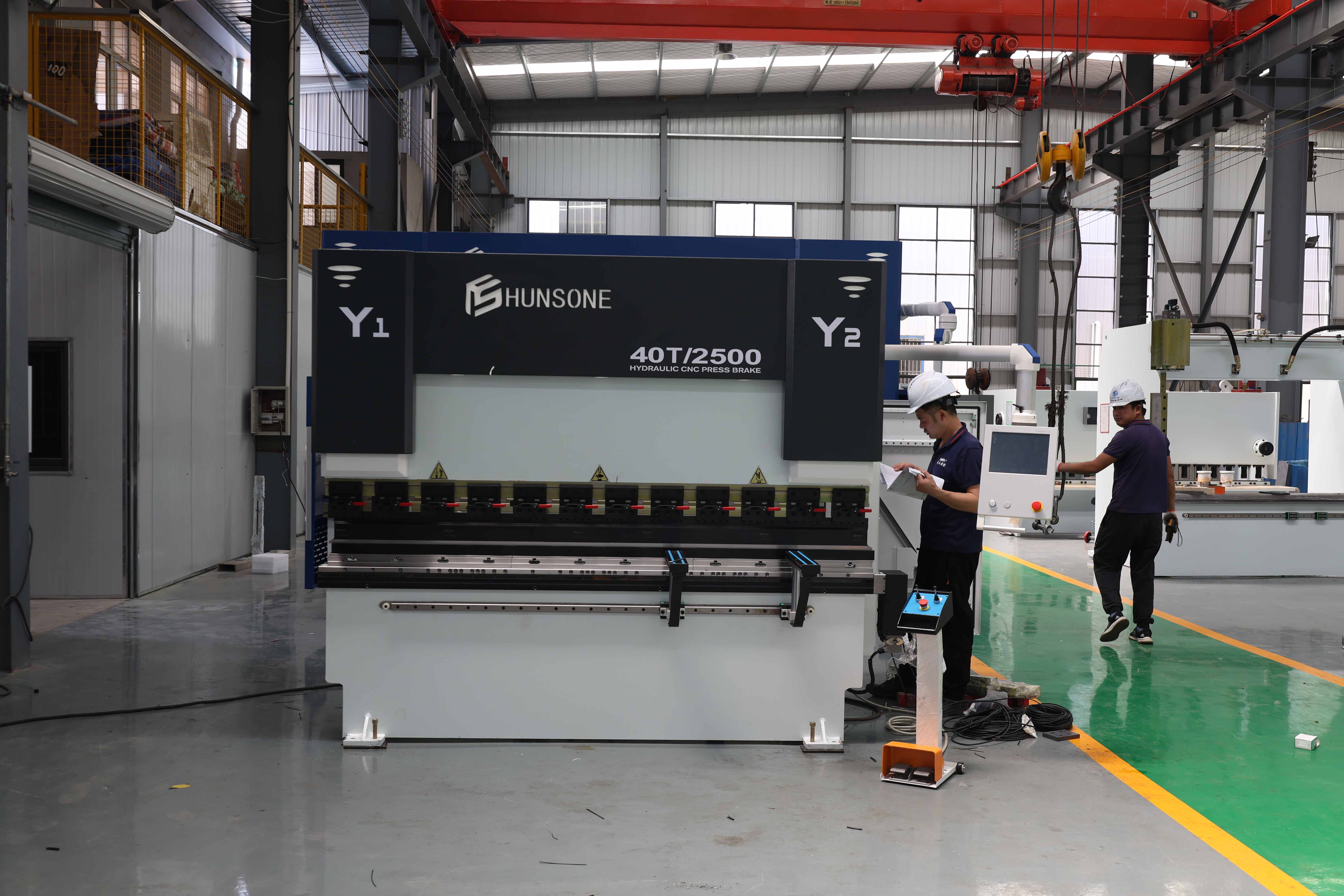
Spec sheets rarely reveal where these two drive systems separate. Put both under a heavy off-center load and the hydraulic machine relies on oil volume and valve response—a system that flexes slightly as seals compress and fluid heats. The electric press brake, by contrast, moves the ram with servo motors and ball screws or belts, so its position stays locked in relation to the encoder feedback. In daily production, this shows up as a stubborn difference in angle repeatability: hydraulics tend to drift through the first few cycles until oil temperature stabilizes, while electrics hold their settings from the first bend to the last with almost no warm-up curve.
Another place the gap becomes obvious is in crowning and deflection control. A hydraulic ram can compensate for bed deflection through shimming or a crowning table, but the system still has to manage compressibility and uneven flow to each cylinder. Electric drives apply force through mechanical links that don't have that spongy middle, so the deflection pattern is more predictable and easier to map. When you bend long parts with holes cut near the bend line, or run small batches with mixed material thicknesses, the electric machine often needs fewer correction passes—not because it's always more powerful, but because its motion is less affected by load shifts.
Maintenance and long-term cost show the third real split. Hydraulic press brakes need clean oil, filter changes, leak checks, and occasional pump or valve rebuilds; those costs arrive on a schedule, but the downtime can hit during a busy week. Electric machines have fewer hydraulic consumables to replace and their energy use drops to near zero between cycles, though large-tonnage electric models still carry a price premium and may not match the brute force of a big hydraulic cylinder for very thick plate. If your shop runs a wide mix of short jobs and wants minimal setup time, the electric's consistency usually wins. If you're bending thick, long parts in long production runs, a well-maintained hydraulic machine still earns its floor space.
What Shop Owners Notice After Six Months of Daily Use
By the six-month mark, the daily routine has settled into something closer to muscle memory. Opening the shop no longer involves double-checking handwritten counts or searching for misplaced invoices. Instead, owners find themselves glancing at a single screen and knowing, within seconds, whether the day is starting in good shape. That quiet confidence is often the first real change they mention.
Staff stop asking where things are or how to process a return. New hires pick up the flow in days rather than weeks, which means the owner isn't tethered to the counter whenever someone calls in sick. The biggest surprise for many is how much mental space opens up once the small, repetitive decisions are taken off their plate. They start thinking about the next season or a window display instead of rechecking stock levels.
Money questions get easier too. Instead of waiting for the accountant's quarterly report, owners can see which items actually pull their weight and which ones just gather dust. That leads to faster markdowns, smarter reorders, and fewer dead ends in the stockroom. After six months, the tool isn't something they think about much anymore—it's just how the shop runs.
Budgeting Without Sacrificing Bend Accuracy
Precision in pipe bending often gets treated as a luxury reserved for expensive tooling or CNC setups. Yet small adjustments to your manual process can hold angles tight without adding a single dollar to the budget. Start by confirming your bend deduction numbers with a scrap piece—mark, bend, measure, and adjust the formula rather than trusting a generic chart. A cheap digital angle finder beats squinting at a protractor, and shimming the clamp face with cut-up soda can strips removes most of the slop that eats accuracy. These habits cost nothing beyond a few extra minutes, and they keep your bend allowances repeatable across multiple parts.
Another low-cost lever is controlling springback before it happens. Most benders over-bend blindly, then fight the result. Instead, bend a test coupon from the same batch of stock, note the exact springback in degrees, and dial that into your setup once. Even a manual bender can hit plus or minus half a degree when the operator knows the material’s personality. Pair that with a simple wooden V-block jig for checking bend angle right at the machine—no granite table or laser needed. The whole setup might cost you a Saturday afternoon and some scrap lumber, but it removes guesswork from every subsequent bend.
Finally, don’t underestimate the value of clean reference edges and consistent clamping pressure. A deburred cut end seated firmly against the backstop prevents the part from shifting ever so slightly under load. Use two C-clamps instead of one if the workpiece wants to wander, and mark your die position with a paint pen so you return to the same place every time. These are not budget-breaking changes; they are reminders that bend accuracy lives in repeatable habits, not in the price tag of the machine.
Maintenance Habits That Prevent Costly Downtime
Skipping a scheduled lubrication on a conveyor bearing may not feel urgent in the moment, but that small oversight can seize a drive shaft during peak production. The most reliable plants treat lubrication and inspection routes as non-negotiable rituals. Technicians carry printed checklists, mark deviations immediately, and replace worn belts or seals before they show visible damage. This habit shifts the focus from reacting to breakdowns toward owning a machine's health week after week.
Another habit that quietly prevents expensive failures is condition monitoring with simple, repeatable measurements. Recording vibration readings on critical pumps, checking motor temperatures with an infrared gun, and logging pressure drops across filters takes only minutes but builds a trend history that often reveals trouble weeks ahead. When a reading drifts outside its normal band, the team can schedule a short repair during a planned changeover instead of paying for emergency labor and overnight freight. Consistency in collecting and reviewing that data is what separates plants that rarely stop from those that lurch from one crisis to the next.
Questions to Ask Before You Commit to a Model
Before you get attached to a particular model, dig into what you're really asking it to do. Is your data tabular, sequential, spatial, or a mix? Does the model's structure mirror the relationships you suspect exist, or are you forcing a square peg into a round hole? Ask whether the assumptions behind the algorithm—linearity, independence, stationarity—hold up against the messy reality of your dataset. A model that shines on benchmark tasks might crumble when your labels are noisy or your features shift over time.
Equally important is the operational side. Can you explain the model's decisions to stakeholders, or at least to yourself? What happens when it fails—does it degrade gracefully or produce confident nonsense? Consider the full lifecycle: training time, inference latency, retraining cadence, and whether your team can debug it next year. If the answer to any of these is "we'll figure it out later," you're not choosing a model; you're borrowing trouble.
FAQ
Focus on material thickness, bend length, and tonnage requirements first. After that, consider the control system and back gauge accuracy, those often decide how quickly you can set up a new job. Hydraulic machines are common, but electric servo models can cut energy use significantly if you run lots of short batches.
A common starting point is to use the material's tensile strength, thickness, and the die opening. For air bending mild steel, you can estimate around 1.5 times the tensile strength times the thickness squared divided by the die opening. But don't skip the tooling factor and bend length, getting those wrong leads to either an underpowered machine or wasted capacity.
It depends on your workload. Hydraulic press brakes offer high force at lower cost and are forgiving with heavy plate, but they run continuously. Electric servo models are quieter and more energy efficient for light-to-medium work. Hybrid designs combine hydraulic force with electric control, giving good repeatability without the full energy drain.
A well-maintained used machine can be a bargain, especially if you only need basic bending. Check the ram parallelism, back gauge repeatability, and hydraulic leaks before committing. Expect to spend some money on calibration and possibly new tooling, so factor that into the total cost.
NC controls typically handle simpler jobs with manual data entry and limited axes, which is fine for repeated bends on the same part. CNC controls give you multi-axis positioning, graphical simulation, and stored programs for complex or varied work. If your parts change often, CNC usually pays for itself in reduced setup time.
Back gauge accuracy directly affects bend location and consistency. A gauge that drifts by even 0.1 mm can cause out-of-tolerance parts in precision sheet metal work. Look for a gauge with rigid guides, a stable reference point, and at least two axes if you need to position parts at different heights.
At minimum, get light curtains or laser guards that stop the ram if something enters the danger zone. A two-hand control or foot pedal with a guard is also standard. Newer machines often include a speed monitoring system that switches to slow bending speed near the material, worth the extra cost for reducing injuries.
Crowning compensates for deflection in the bed and ram, which is critical for long bends over 2 meters. Without it, the center of the bend may have a different angle than the edges. If your parts are long or require consistent angles across the full length, get a machine with automatic crowning.
Conclusion
Comparing press brakes goes beyond tonnage and bed length. The real distinctions emerge in how the machine handles daily workloads—hydraulic systems tend to offer raw power and forgiveness on thick material, while electric brakes shine in speed, repeatability, and lower energy use, though they demand precise tooling setup. Shop owners often mention that after six months, what they value most isn't the spec sheet but how consistently the ram returns to the same position without drift, and how easy it is to train someone on the controls. Accuracy comes down to the frame's rigidity, the quality of the crowning system, and whether the CNC controller actually compensates for material springback instead of just displaying numbers.
Budgeting realistically means accounting for tooling, installation, and training, not just the base price—cheap machines often lose money through scrap and rework. A maintenance routine that includes daily lubrication checks, hydraulic fluid sampling, and periodic backlash measurement prevents the kind of unexpected downtime that kills delivery schedules. Before committing, ask how the builder handles support after installation, whether replacement parts are stocked locally, what the actual power consumption looks like under your typical bend profile, and if the control software is something your operators will actually use rather than fight. A press brake is a long-term partner in the shop; the right choice reflects how you work, not a generic ranking.
Contact Us
Contact Person: James Chen
Email: [email protected]
Tel/WhatsApp: 86 13770803946
Website: https://www.hunsone.com/